

Planning a client’s Vietnam itinerary starts with one question: which regions fit together logically within the days available? A generic tourist map answers “what’s here,” but travel agents need something more actionable, a working reference that connects geography to real transfer times, flight routing, and seasonal timing. This guide breaks down Vietnam’s map by region, shows how ground operators use it to sequence itineraries, and flags the routing details that matter most for agents booking clients from India and other international source markets.
1. Understanding Vietnam’s Geography: Why the Map Shapes Every Itinerary
Vietnam stretches roughly 1,650 kilometers along Southeast Asia’s eastern coast, from the mountainous north bordering China down to the Mekong Delta near Cambodia. That length means climate, culture, and travel time vary dramatically depending on where a client starts and ends. A common planning mistake among agents new to the market is treating Vietnam like a compact, single-zone destination. In reality, moving from Hanoi in the north to Ho Chi Minh City in the south takes roughly two hours by domestic flight but is not feasible by road within a standard tour window. Understanding this north-to-south spread is the foundation for building a realistic, sellable itinerary rather than an overloaded one.
2. Vietnam Travel Map by Region
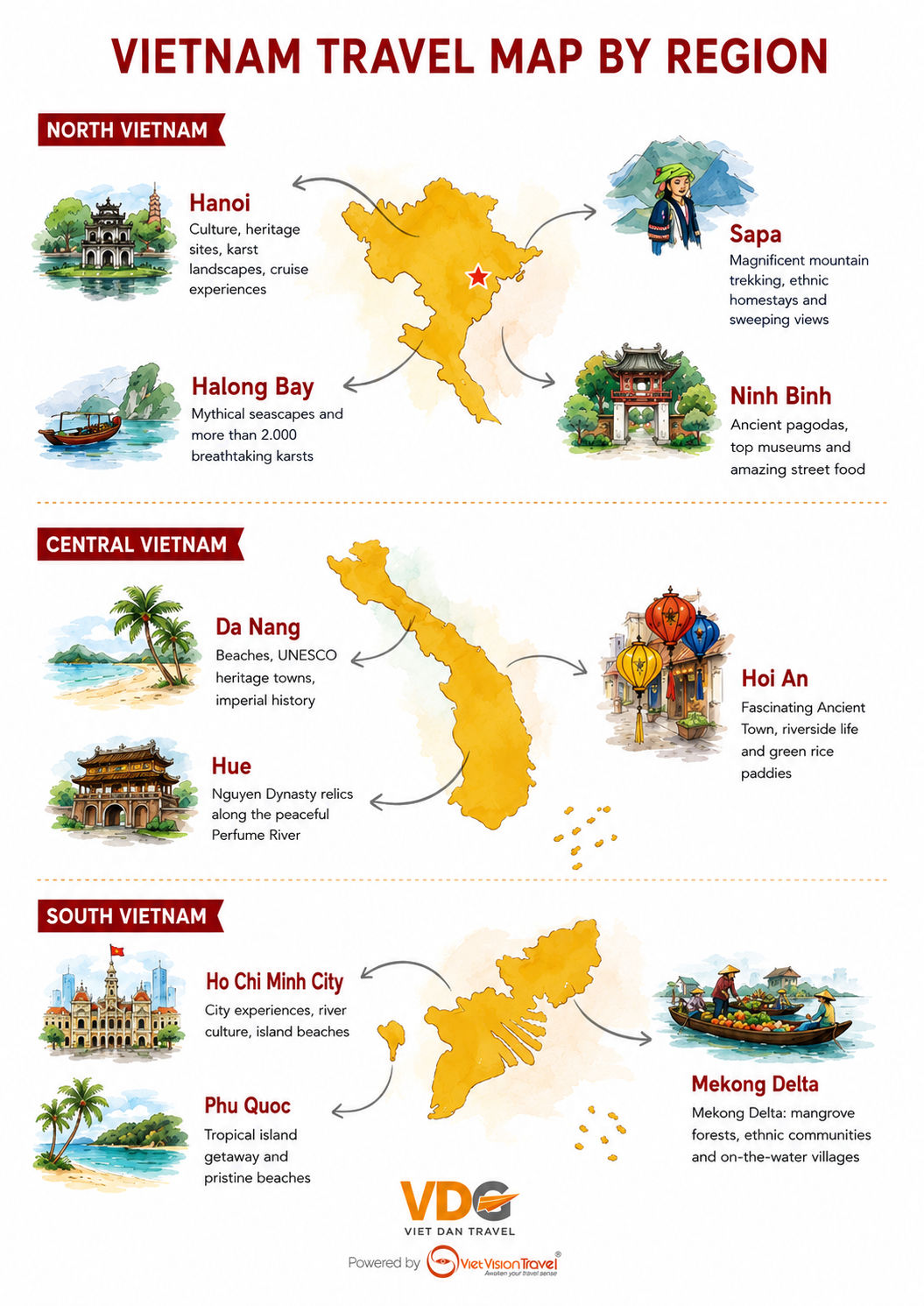
Vietnam divides naturally into three planning zones. Each has a distinct character, and most itineraries are built by combining two or three zones depending on trip length.
| Region | Key Cities/Destinations | Best For | Typical Internal Transfer Time |
| North Vietnam | Hanoi, Halong Bay, Ninh Binh, Sapa | Culture, heritage sites, karst landscapes, cruise experiences | Hanoi to Halong Bay: 2 to 2.5 hours by road; Hanoi to Ninh Binh: 2 hours by road |
| Central Vietnam | Da Nang, Hoi An, Hue | Beaches, UNESCO heritage towns, imperial history | Da Nang to Hoi An: 45 minutes by road; Da Nang to Hue: 2.5 hours by road |
| South Vietnam | Ho Chi Minh City, Mekong Delta, Phu Quoc | City experiences, river culture, island beaches | Ho Chi Minh City to Mekong Delta: 2 to 3 hours by road; Ho Chi Minh City to Phu Quoc: 1 hour by flight |
For agents quoting multi-city itineraries, this table is the starting point for sequencing. North-to-south routing (Hanoi, then Central Vietnam, then Ho Chi Minh City) is the most common flow because it follows a single directional path with domestic flights covering the longer jumps, avoiding backtracking that inflates both cost and travel fatigue for the client.
3. How Travel Agents Use This Map to Build Client Itineraries
A tourist reads a map for inspiration. An agent reads it to solve a logistics problem: how many regions can realistically fit into the number of days a client has booked without over-scheduling transfers? The table below reflects itinerary structures commonly used by ground operators when proposing Vietnam packages to international partners.
| Trip Length | Recommended Regions Covered | Itinerary Logic |
| 7 days | North Vietnam only, or Central plus South | One flight or zero flights minimize transfer fatigue for shorter trips |
| 10 days | North, Central, South (classic route) | One internal flight (typically Da Nang or Hue to Ho Chi Minh City) allows 2 to 3 nights per major stop |
| 14 days | North, Central, South, plus an island extension (Phu Quoc or Nha Trang) | Two internal flights suit FIT travelers and honeymoon or leisure-focused groups wanting a beach close-out |
This is where the ground-level knowledge of a Vietnam DMC adds value beyond what a generic map shows. Agents proposing a 7-day trip that tries to cover Hanoi, Hoi An, and Ho Chi Minh City in one week are setting the client up for a rushed experience with too many hotel changes. Viet Dan Travel works directly with partner agents to validate that a proposed regional combination matches the trip length before quoting, which prevents itinerary revisions later in the sales process.
4. Vietnam Airports Map for International Routing
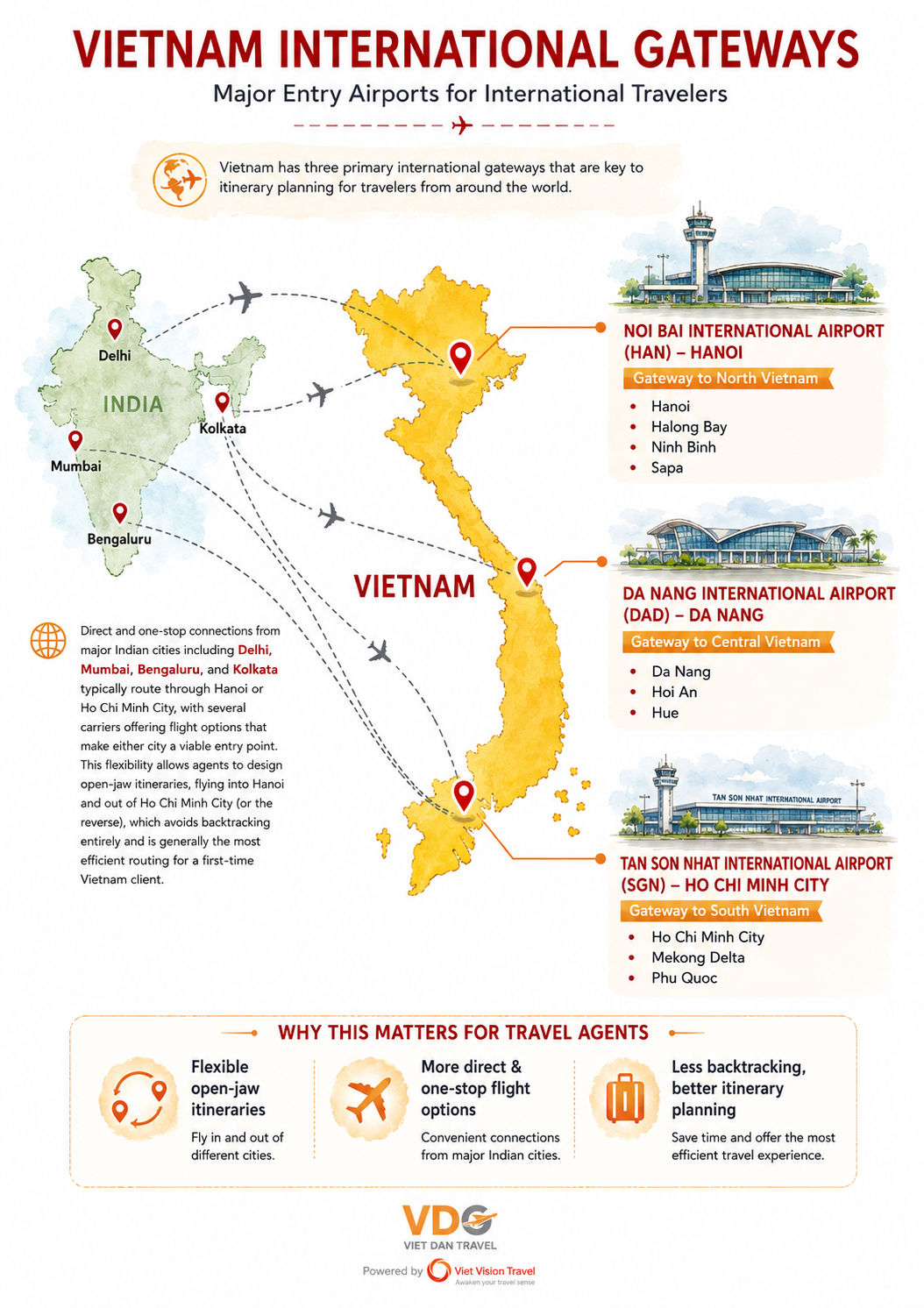
For agents booking clients from outside Vietnam, the airport map matters as much as the tourist map. Vietnam has three primary international gateways relevant to itinerary planning:
- Noi Bai International Airport (Hanoi), serving North Vietnam entry
- Da Nang International Airport, serving Central Vietnam entry, with a growing number of direct international routes
- Tan Son Nhat International Airport (Ho Chi Minh City), serving South Vietnam entry and the busiest gateway overall
For Indian travelers specifically, direct and one-stop connections from major Indian cities including Delhi, Mumbai, Bengaluru, and Kolkata typically route through Ho Chi Minh City or Hanoi, with several carriers now offering flight options that make either city a viable entry point. This flexibility means agents can design open-jaw itineraries, flying into Hanoi and out of Ho Chi Minh City (or the reverse), which avoids backtracking entirely and is generally the most efficient routing for a first-time Vietnam client.
5. Seasonal and Regional Planning Notes for Indian Travelers
Vietnam’s regions don’t share a single weather pattern, which is a detail many generic travel maps skip entirely but matters for accurate client advice.
- North Vietnam has a cooler, drier period from October through April, making it the preferred window for Halong Bay cruises and Sapa trekking
- Central Vietnam sees its rainy season from September through December, so beach-focused Hoi An or Da Nang itineraries are better positioned from February through August
- South Vietnam stays warm year-round with a wet season from May through October, though short afternoon showers rarely disrupt sightseeing
For agents planning around Indian holiday calendars, the North Vietnam dry season overlaps well with Diwali season travel and winter school-holiday windows, while the Central Vietnam dry season aligns with the popular April to June leisure travel period from India. Agents building destination wedding or MICE proposals should also factor regional weather into venue selection, since outdoor mandap or baraat setups are more weather-dependent in Central Vietnam during its wet months.
6. FAQ: Vietnam Travel Map Questions from Travel Agents
Which Vietnam region should I recommend for a client’s first trip?
For a first-time visitor with 7 to 10 days, Hanoi to Ho Chi Minh City with a Central Vietnam stop in between covers Vietnam’s most requested experiences without overloading the schedule.
How many internal flights should a Vietnam itinerary include?
Most itineraries under 10 days work well with one internal flight. Longer itineraries covering all three regions plus an island extension typically need two.
Is it better to fly into Hanoi or Ho Chi Minh City for Indian clients?
Both cities have workable international connections from major Indian cities. The better entry point usually depends on which region the client wants to see first, since an open-jaw itinerary flying into one and out of the other avoids backtracking.
What is the best season to book Vietnam for Indian travelers around Diwali?
North Vietnam’s dry season, running roughly October through April, aligns well with the Diwali travel window and offers cooler, clearer conditions for sightseeing and cruise itineraries.
A map shows geography. It doesn’t show which combinations of regions actually work within a client’s timeframe, budget, or season. That’s where a ground DMC becomes essential to the planning process. Viet Dan Travel works directly with international travel agents and tour operators to validate itinerary logic, confirm current transfer times, and quote accurate multi-city packages, so agents can present clients with routes that are both appealing on paper and realistic on the ground. For partner support on custom itinerary building, contact Viet Dan Travel, our experts are willing to help at anytime!
Note: Flight routes, transfer times, and seasonal patterns referenced above are general planning guidelines as of 2026. Agents should confirm current routing and pricing directly with Viet Dan Travel before quoting clients.